
I purchased a book when I was in Las Vegas a few months ago titled, History, Myths, and Sacred Formulas of the Cherokees, and quite immediately opened the book to chapter 4, The Myths, Cosmogonic Myths. After perusing the creation myth, I was immediately taken by the section 3, Kana'ti and Selu: The Origin of Game and Corn. I had already determined to my own satisfaction that Goddess Selu, the Cherokee Corn Goddess got her name from the Sanskrit word selu, which means "abundance." Anthropologically speaking, corn is synonymous with abundance. Kana'ti, the "Lucky Hunter God," seems likely to correspond to the Sanskrit word kSAnta, which means "of a hunter," among other things. Upon a second reading, I determined that the Cherokee myth about Kana'ti and Selu and their sons is in fact a retelling of certain Hindu myths about Shiva and Parvati and their sons.
I had previously read of the murder of Selu by her own sons, who saw her manifesting corn by rubbing her belly else by similar means, and thus killed her for being a "witch." I didn't know of the story of the advent of one of the two sons from the waters of the river, however, until I started to peruse the aforementioned book.
At first the Kana'ti and Selu had only one son. According to the account given, "The little boy used to play down by the river every day, and one morning the old people thought they heard laughing and talking in the bushes as though there were two children there. When the boy came home at night his parents asked him who had been playing with him all day. "He comes out of the water,"said the boy, "and he calls himself my elder brother. He says his mother was cruel to him and threw him into the river." Then they knew that the strange boy had sprung from the blood of the game which Selu had washed off at the river's edge."
One of Great Goddess Parvati's Avatars is as Annapurna, who is Goddess of Food and Nourishment. Great God Shiva is depicted in Hindu myth as a skillful hunter who often disappears into the forest on hunting forays. According to Hindu myth, Shiva and Parvati's son Kartikeya, also known as Skanda, was born in a bed of reeds on the edge of the Ganges when Great God Shiva on one occasion spilled His seedinto the Ganges, where said wad floated into a bed of reeds, in one version of the myth of the birth of Kartikeya. In other versions, the Devas and Devis (Gods and Goddesses) conspire to bring Kartikeya into the world by delivering Shiva's seed into the flow of the Ganges. Kartikeya is the elder brother of Ganesha, the popular elephant-headed God of Hindu myth.
Clearly, there seems to be more than coincidence involved in these two myths conveying such similar mythemes, telling such parallel stories. I have already drawn parallels between the as yet undecifered script of the Indus Valley Civilization of 1500-5000+ BCE and the petroglyphs and pictographs and architecture of pre-Columbian America, as well as noting many nigh if not precise cognates between Sanskrit and various Native American languages in previously published posts (see previous posts, "A Few Examples of Indus Valley Script and Hindu Gods Found in Native American Indian Rock Art" and "Maybe Columbus Found India After All: Traces of India Amongst American 'Indians'").
The clear parallels between the myth of Kana'ti and Selu and there two sons and Shiva and Parvati and their sons Ganesha and Kartikeya further reifies my contention that Native American Indians are indeed, to some degree, the progeny of colonists from India and Southeast Asia, however many thousands of years ago. Native American Indians are indeed not entirely misnamed, as such.
Namaste
Thursday, March 5, 2020


Monday, August 26, 2019
Beyond "To Be or not to Be," Beyond Dualism, Beyond Duelism (Portions of a Chapter for An Upcoming Book)
Dualism and the Dark
Age
Dualism.
Dvaita.
The bane of good souls and the people generally in the Kali Yuga.
“Us vs. Them,” “God vs. the Devil,” and divisions into binary
dualisms generally is the great cause of suffering in this Age. The
proclivity to create “the Enemy/enemies” else to manufacture a
“scapegoat” is the primary problem proffered humanity in this
Dark Age.
The
Jewish people created a succinct dualism by calling themselves “God's
chosen people,” more than implying that the rest of the world was
“not-chosen.” In Abraham's apparently complete break with his
ancestors' and their religion, and exemplified by the Hebrew people's
historic practice of killing every man, woman, child and animal
amongst their foes, the Hebrew construction of reality is very much
based on an absolute rejection of anyone “not-us.”
Christians
seperate themselves from God by their notion of the “sin nature,”
and from the rest of the world by the dichotomy of “the saved”
vs. “the lost,” this despite the fact that their own scriptures
tout that Jesus Himself is recorded as having said that He came to
save the Jews, not the Gentiles, not the rest of the world's people.
His supposed followers are the ones who decided that Jesus came to
save the whole world, AFTER Jesus had parted from their company. Not
unrelatedly, it seems many Christians (though not all, mind you) seem
to have more faith in the existence of evil and “the Devil” than
in the integrity and compassion of God, and in fact thus empower and
give license to veritable “evil” and to a great many injustices
by their animosity towards the rest of the world/non-Christians and
by narrowly prejudiced judgement of any perspective that disagrees
with their particular dogma.
The
Muslims seperate themselves (and to some slight degree, the “people
of the book,” Jews and Christians) from “the infidels,” and
from all (including Jews and Christians) who do not accept “the
kalima,” the Muslim's all-important confession of faith in Allah
and Mohammed. Though the Hebrews eradicated their conquered foes,
and the Christians try to “save them,” the early Muslim conquests
only attempted to eradicate those who would not convert (other than
Jews and Christians) amongst those they conquered. Jewish or
Christian cities the Muslims had conquered who would not convert were
granted “djimi”
status
and
levied a one percent poll tax and granted self-rule. Regardless,
Islam is still based on a succinct dichotomy of “us vs. them,”
despite the less succinct separation they place between themselves
and the “people of the book.”
The
Abrahamic religions are all three too much caught up in the fear or
pride based division/delusion of “us vs. them,” and are thus
blinded to the beautiful Oneness of God and all that truly Is, to the
reality that beyond the illusion of time and space humanity and all
beings and Being are Advaita,
literally “not-second,” not in truth other than the First, the
Eternal, brahman,
“God.” All else is illusion and delusion, forgetfulness of our
true Nature as Divine.
A Sikh saint once said, upon being chastened for pointing the bottom
of his feet towards the altar at a temple, “Where might I point the
soles of my feet where God is not?”
In
this last Age of a cycle of four Ages, the Kali Yuga, The “Dark
Age,” our most dumbed-down state, most forgetful of the intrinsic
Unity of All with the Divine (one's True Self), a base response to
trauma or suffering is to blame someone or something “other,”
forgetting that in truth there is no real “other,” and certainly
no “Other.” People in this age generally are rather prone to
creating quite terrible and nasty enemies for themselves out of
whatever “other” is available, and too often in the name of
“God.”
The
easiest division to make cognitively is a bifurcation, to split
things into whatever “this vs. that” or “us vs. them” is at
hand, the which is nigh always an error, an error that in most cases
leads to much suffering and injustice. In this Age when we're at our
stupidest (compared to the last three Ages, so it is said) such easy
constructions as a simple binary offers are too often the choice of
people when facing conflict, rather than to consider the intricacy
and multiplicity of factors involved in any such scenario, process
or set of relationships, and the intrinsic connectedness if not unity
of all things.
Inclined
to think in binaries, most in this Dark Age cannot clearly discern
what the Isa Upanishad means by the assertion that “He who sees all
beings in his Self, and his Self in all beings, what fear does he
have?” At least a base symptom of the malady of the Kali Yuga is
the proclivity to blame someone else, to construct an “other” as
the enemy or scapegoat or as “the one/ones who need to change,”
rather than recognizing the supposed “other” as like you and even
another expression of the same Divine Self, another player in the
Grand Play of life on Earth on a like pilgrimage through the lila
of eternity, and that what one has the certain power and right to
change is his or her own self in relation to the Divine that exists
both inside and out, and the right to change one's own life
practices.
Now
mind you, I do recognize that in this presentation of the play of
these religious perspectives I am myself thus constructing a division
of us vs. them, “them” being the Abrahamic religious discourse as
opposed to “us” who can see the delusion of dualism. I suppose I
must clarify by noting that as I am refering to these various
religious groups I am speaking of the general discourse said groups
proffer in general terms, and do not mean to essentialize all
practitioners as fitting within those generalities. There are within
all peoples and among all groups of religious practitioners some
Self-aware individuals, and coversely some Hindus and Buddhists who
are prone to such “us vs. them” delusions, despite the very clear
precepts of both religions that teach otherwise, that both teach
ahimsa
and satyagraha
and
extreme restraint as the generally proper response to conflict with
supposed “others” presented us in the midst of this Grand
Illusion, the matrix of smoke and mirrors that is maya.
To
reify, I do not wish to imply that among the practitioners of the
“Abrahamic” faiths there none who are Self-Aware individuals, nor
that they should renounce their religions, nor that those religions
are in essence “bad” nor “evil.” I only mean that those
constructions are prone to dualistic renderings of conflicts and
interactions generally, whereas constructions that do not create such
stark and arbitrary separations between “us and them,” between
“God” and humanity, between Nature and civilization, do indeed
prove more harmonious and in concert with what really is. Reality is
in fact and by any reasonable scientific purview never truly a binary
function of off/on, us/them, self/not self, saved/lost, the
faithful/infidels, black/white, nor even of male/female, and such
integrous worldviews as do not promote such ignorant dualistic
thinking are more prone to fomenting peace and genuine prosperity,
both amongst their own and in the world generally.
The
complexity and intricacy of reality and Being cannot ever quite be
fitted to within the base dichotomy of black and white, save perhaps
by tandava.
The closest the teachings of sanAtana
dharma
come to a black/white dichotomy in terms of cosmology is in the
Dance, the Tandava, of Shiva and Kali Ma, wherein an Effulgent
(though not necessarily “white”) Dude is dancing with The Black
Mama, the two always in motion and thus not ever quite merely two,
but existentially both Many and One; the Great Mama, Dark like the
depths of the Womb, conveying all the Sensuality and Beauty and
Potency of Feminine, of The Mother, and the Great Papa, Protector of
Souls and Animals and the Source of Light, together in constant
Motion conveying Devotion and Passion and Playfulness and indeed,
Desire, but never quite presenting merely Two, and never in truth
other than One.
Indeed
as these various groups, faiths, peoples and lifeways have developed
to be such significant factors in this world at this or any time,
they are each certainly variously cast to play particular roles in
the lila
of the Kali Yuga, or to be more specific, the Gauri Yuga of the Kali
Yuga, as these are Golden times compared to what awaits as the
dualistic, “us vs. them” darkness ensues as the rest of the Dark
Age continues after the Golden Age part, according to the teachings
of sanAtana
dharma.
Indeed the Gods are at play, only they are not-not us.
The
various religious constructions of this world, indeed all of the
variegated arrays of paradigms and peoples, can be seen as
strategically deployed to create means of transforming the
self-destructive impetuses of this Age of Ignorance, to distribute
the cognitive malaise and confusion of reality caused by the
dualistically debased state of human cognition in such ways as such
dimwittedness might cause the least sorrow and suffering. It is not
unlike a board game played with the planet as board, with the Players
being Devas and Devis and other orders of beings, and by the ancient
accounts of many traditions, extra-terrestrials from various star
systems that have been involved in many of the acts and scenes across
the Ages and Play cycles played out via humans and their tribes and
civilizations, nations and religions and philosophical disputations,
at least according to the ancient teachings of sanAtana
dharma
and many other more recent if still ancient mythologies. And indeed
when seen true, the Play and Plays of life on earth is merely a game
God/True Self is playing with HerSelf/HimSelf in this Illusion born
of Desire.
The arrangements and rearrangements of peoples designed to foment
peace and find good balance to the diversity of peoples and lifeways
can be discerned in the Grand Narrative if one shifts one's focus to
include the span of eternity, of forever, and to the entirity and
integrity of the show here and now, and not merely one's own or one's
own people's seeming separate story, but the whole show and all the
nata
(actors, players/dancers) integrously dancing towards the perfect
bliss and synchronicity that is in truth all that Exists.
One
clear example of the above theory, of the Gods engineering the
development of human civilization, would be the aforementioned
movement of King Bali's Kingdom to across the Pacific at the firm
request of Vaman (Dwarf Avatar of Vishnu), who granted the
“Underworld” to Bali that Lord Indra could reign unhindered
across the Eurasian and African landmasses, i.e., not unlikely to
prevent war between the two powerful kings, as well as certainly to
fulfill so many subtle intentions of the script of the Grand lila
at play in the Gauri Yuga of the Kali Yuga.
Traces of Lord Indra's rulership are to be found in the figurations
of very analagous gods like Zeus, Thor, Jupiter, Perun, Marduk, etc.,
and likely various gods in the African pantheons, and traces of
Bali's kingdom in Patala well enough evinced by the Saksaywaman
Temple, clearly built to honor Deva (God) Vaman (Vishnu's fifth
Avatar of Ten), and many other linguistic and cultural clues.
We
are the playthings of the Gods and We are the Gods—if forgetful
ones, mind you, or at least so it seems to me. And more importantly,
we are God. Not our individual selves/jiva/souls/egos
else ids, mind you, caught up in karma (action) and desire as nigh
all are to whatever degree, but our True Self, the Eternal One that
resides in and outside each and every, that resides in everyone's
heart, about the size of your thumb, the Upanishads do tout. sat
cit Ananda,
“righteous mind bliss” as what is Natural and is Nature. “Sin
Nature” as what is Natural is a terrible lie, a copout, a crutch to
enable or attempt to justify people doing wrongs.
In
these dimwitted days of the Kali Yuga, many ifn't most are prone to
miss the beautiful complexity and multifaceted nature of what is
real, and instead are sadly prone to lump things into stupid binaries
and thus to heap sufferings and sorrows upon themselves and others.
It's easy to make a scapegoat, but such never truly serves the
abiding good of the people.
My
wish for the Abrahamic religions, and any crew inclined towards
binary stupidity in an Age beset by said malady, is that they become
respectfully aware of the many respective roles to be filled in this
Age-long play that has scarce begun, and become duly aware that
though some of their own presumptions and dogmas are wrong and
mistaken, as are some of those of other peoples and religions, all do
fit in the Divine Play at hand, and all peoples and their lifeways
and religions do contain the seed of righteousness, of the
Compassionate and Eternal Divine. Truly, diversity is vital to life
lived, and everyone's own place and conditions of birth and the
practices of their people do somehow fit into the Grand Play
integrously and do provide possible pathways to Divine bliss, as it
is with all peoples and good practice and well kept tellings of the
ancient and abiding Story and Stories.
Requisite
for a well developed play are variously arrayed characters and
groups, factions and factors well woven together, preferably in such
concert as to compliment rather than to compete or to dealve into
suffering-filled conflicts. If one can learn to see the Divine in
and through the whole show, and that when seen true, other peoples
and their Gods are true too, all Players in a Game that includes all
people and peoples and times; if one can accept that the Truly
Divine, Compassionate and Great, in whatever variegated forms
sometimes certainly maintains Presence(s) by many names and amongst
various peoples, and even amongst the fold of your “enemies,”
beyond the “us/them,” then, Religion can be true.
Ekam
sat vipra bahudha vadanti
The
Truth is One, the Sages speak of it variously.
Monday, July 29, 2019
A Few Examples of Indus Valley Script and Hindu Gods Found in Native American Indian Rock Art
So I was drawn to an article that touted Chinese bone script had been found in petroglyphs in North America, and I immediately considered that there might likewise be Indus Valley script to be found among the many paintings and etchings rendered by Native American Indians. I had been sometimes seeking Devanagari script among the many figures and forms artistically inscribed upon so many caves and cliffs and random rock outcroppings in the Americas, which would make little sense as said script is sacred in the traditions of sanAtana dharma and was only used in a priestly religious context, as likewise the intoning of Sanskrit mantras was reserved for the brahmin (priestly) caste. The kshatriya caste, and others, would have used a different script in their records and communiques, and the obvious candidate to seek to indicate an Indian colonial presence in the Americas is Indus script, recorded from the finds at Harappa and other sites in the Indus Valley and dating from around 4,000 years ago to over 6,000 years ago (or much older).
The Vishnu Purana tells that Vishnu as Vamana (dwarf or kid Avatar) asked King Bali to cede his lands in Asia, Africa and Europe to Indra (also known as Zeus, Jupiter and Thor, etc.), and to move his kingdom to Patala, the "Underworld." The Egyptians also knew the Americas as "the Underworld" or "the West," and as indicated by the discovery of "the cocaine mummies" whose bodies showed traces of both tobacco and cocaine, substances not known to be grow either naturally nor by cultivation in northern Africa and purportedly only known to the Americas previous to European colonization, indicating overseas trade between Egypt and "the Underworld/the West."
Inca temple Saksaywaman corresponds rather obviously to the Sanskrit "sakshat vaman," which translates to "in the presence of Vaman," the Avatar of Vishnu who asked King Mahabali to move to Patala/ "America." "Saksay or Saqsay is a Quechua word meaning, `to be full’, and Waman is the Hawk (or person travelling on Hawk)."(https://www.booksfact.com/religions/machu-picchu-saksaywaman-vamana-temples-cusco-peru.html). Vishnu's vehicle is Garuda, an eagle/raptor, quite clearly indicating that Saksaywaman is a Vishnu Temple.
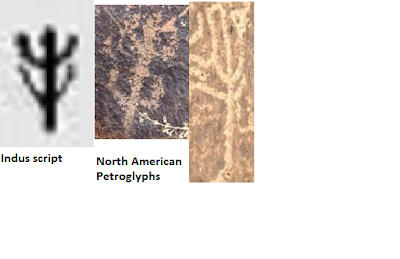
I've noted the above to introduce the purport of this treatise, which is that much of the script inscribed as petroglyphs in North America is of a nigh universal script that was most succinctly recorded in the Indus Valley and has become known as the undecipherable Indus script. My contention is that colonists from Indus Valley civilization came to the Americas on multiple occasions over the past several thousand years (as did people from many civilizations), and the traces of this can be found in petroglyphs bearing clear similarity to Indus script, as in the many cognates and nigh cognates between Native American Indian languages and Sanskrit, and via other clues that tell that Native American Indians were indeed to some degree the progeny of colonists from Asia and the same civilization that has become known as "Indus Valley Civilization."
It has been noted by some theorists that the script found on Easter Island, Rongorongo, shares many symbols with Indus script, indicating that peoples connected to Indus civilization made it at least so far as half-way to Patala/the Americas. If indeed King Bali's people crossed the Pacific, and were using Indus script as their means of written communication, then such should indeed be found among the many petroglyphs of the Americas. The following are a number of the most obvious or likely matches among the North American petroglyphs I found depicted across the internet. It is my assumption that there was in fact a globally recognized script used on every continent (if not yet discovered in Antarctica), and that at least some portion of these symbols were universally recognized. Among the more significant portion of the influence in regard to American petroglyph script was due to colonists from Asia connected to Indus Civilization. Certainly runes and not unlikely early Chinese script, as well as other symbols from explorers, colonists and merchants from around the world over milennia are to be found amongst the variegated inscriptions and cave paintings of the ancient Americas. I would argue that a primary source of the script used in at least Native American Indian petroglyphs and rock art is directly derived from the Indus script, as the result of multiple waves of colonization across the ocean from Indus Civilization and related peoples.
Unless otherwise indicated, the Indus script is represented by the black and white print figures.




Draw your own conclusions from the above correlations, and check back as more Indus script and American petroglyph matches are on the way . . .


The Vishnu Purana tells that Vishnu as Vamana (dwarf or kid Avatar) asked King Bali to cede his lands in Asia, Africa and Europe to Indra (also known as Zeus, Jupiter and Thor, etc.), and to move his kingdom to Patala, the "Underworld." The Egyptians also knew the Americas as "the Underworld" or "the West," and as indicated by the discovery of "the cocaine mummies" whose bodies showed traces of both tobacco and cocaine, substances not known to be grow either naturally nor by cultivation in northern Africa and purportedly only known to the Americas previous to European colonization, indicating overseas trade between Egypt and "the Underworld/the West."
Inca temple Saksaywaman corresponds rather obviously to the Sanskrit "sakshat vaman," which translates to "in the presence of Vaman," the Avatar of Vishnu who asked King Mahabali to move to Patala/ "America." "Saksay or Saqsay is a Quechua word meaning, `to be full’, and Waman is the Hawk (or person travelling on Hawk)."(https://www.booksfact.com/religions/machu-picchu-saksaywaman-vamana-temples-cusco-peru.html). Vishnu's vehicle is Garuda, an eagle/raptor, quite clearly indicating that Saksaywaman is a Vishnu Temple.
I've noted the above to introduce the purport of this treatise, which is that much of the script inscribed as petroglyphs in North America is of a nigh universal script that was most succinctly recorded in the Indus Valley and has become known as the undecipherable Indus script. My contention is that colonists from Indus Valley civilization came to the Americas on multiple occasions over the past several thousand years (as did people from many civilizations), and the traces of this can be found in petroglyphs bearing clear similarity to Indus script, as in the many cognates and nigh cognates between Native American Indian languages and Sanskrit, and via other clues that tell that Native American Indians were indeed to some degree the progeny of colonists from Asia and the same civilization that has become known as "Indus Valley Civilization."
It has been noted by some theorists that the script found on Easter Island, Rongorongo, shares many symbols with Indus script, indicating that peoples connected to Indus civilization made it at least so far as half-way to Patala/the Americas. If indeed King Bali's people crossed the Pacific, and were using Indus script as their means of written communication, then such should indeed be found among the many petroglyphs of the Americas. The following are a number of the most obvious or likely matches among the North American petroglyphs I found depicted across the internet. It is my assumption that there was in fact a globally recognized script used on every continent (if not yet discovered in Antarctica), and that at least some portion of these symbols were universally recognized. Among the more significant portion of the influence in regard to American petroglyph script was due to colonists from Asia connected to Indus Civilization. Certainly runes and not unlikely early Chinese script, as well as other symbols from explorers, colonists and merchants from around the world over milennia are to be found amongst the variegated inscriptions and cave paintings of the ancient Americas. I would argue that a primary source of the script used in at least Native American Indian petroglyphs and rock art is directly derived from the Indus script, as the result of multiple waves of colonization across the ocean from Indus Civilization and related peoples.
Unless otherwise indicated, the Indus script is represented by the black and white print figures.


Indus script the two figures to the left.


Indus seal figure to the left.


Indus script symbol to the left of petroglyphs.


Indus seal script above to the left.

Indus script swastikas on top depicting both left and right hand swastikas.

The above shows (clockwise from bottom right: Pasupati, Protector of Animals and Souls, on Indus Valley Seal; the Gundestrup Cauldron found in Denmark; Native American Indian petroglyph in the Western United States, and Indus Valley symbol depicting an archer.

Three-headed petroglyph and murti of Trimurti ("Trinity") Brahma, Vishnu and Shiva.


Above is Kartikeya upon His Vehicle, a peacock, and to right a similar petroglyph in North America. Read more about the journey of Kartikeya as He was racing His Brother Ganesha around the world, and the traces Kartikeya left in His wake across Africa, Europe, the Americas and Polynesia:
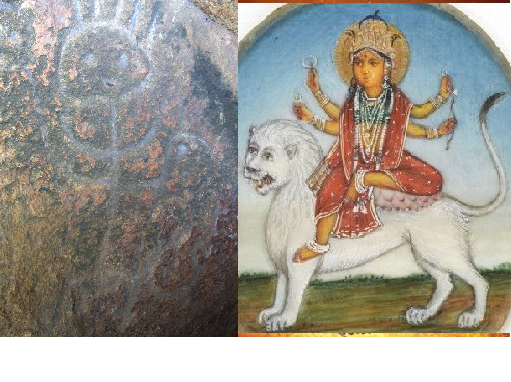
...and yet more indications that Native American Indians were (to some degree) descendants of colonists from India:


The Horned God Depicted in numerous North American Petroglyphs, on the Gundestrup Cauldron found in Denmark, and on the Pasupati Indus Valley Seal.




Thursday, January 10, 2019
“God” is Really the Lord of Hell and “the Devil” is Really God . . .?
To simply state the gist of my theory, the Hebrews were Hindus, or at least Abraham and his forefathers were before his tribe went west to Palestine (a theory many espouse outside of the official Western religio-historical establishment), and their god “Yahweh” bears much resemblance to and is likely derived from Deva Yama, the Hindu Lord of Death and Hell. The Judeo-Christian “Devil,” in terms of the origins of said figure, similarly bears more than mythological resemblance to the God of Abraham's forefathers, Shiva (known as the Horned God to pre-Christian Europe), and possibly to Shiva's Consort, Devi Lalitha (Goddess Lalitha).
Below is the Indus Valley Seal showing Pasupati Shiva, and the Gundestrup Cauldron found in Denmark depicting the Horned God that European Christendom turned into "the Devil."


Below is the Indus Valley Seal showing Pasupati Shiva, and the Gundestrup Cauldron found in Denmark depicting the Horned God that European Christendom turned into "the Devil."

In other words, over the course of the development of the Abrahamic religions, Yama, the Hindu Lord of Death and Hell, was rendered as “God” (Hebrew Yahweh), and the figure who was formerly “God” (Sanskrit Brahman), i.e., to Abraham's forefathers, became figured as “the Devil” by the renderings of Judeo-Christian mythology. Related to these conjectures, it seems the Hebrew rite of circumcision is similarly derived from a Hindu incest taboo rite.
I'll begin by noting something that bothered me from my days as a Southern Baptist minister and perhaps before. Back in the day before I realized myself a yogi, whilst an undergraduate student at Oklahoma Baptist University and pastor at the First Baptist Church of Connerville, Oklahoma, or perhaps before (I resigned and later renounced all trappings of my ministry and moved to Chicago for grad school at the U of C after finishing my undergraduate degree), I made note of a rather confusing idiosyncrasy regarding the Judeo-Christian concepts of Heaven and Hell.
According to Jewish tradition, the destination of righteous Jews after they die is a place called “the Bosom of Abraham” or “Sheol” (New Testament, Luke 10:22). Sheol is described as “down,” as in underground (Old Testament/Torah, Genesis 37:35). The Hebrew word Sheol is generally translated to the Greek word “Hades” in the Septuagint (Greek translation of the Old Testament), and that Greek term generally translates to the English “Hell,” if you didn't know!! This troubled me a bit, but I brushed it aside, assuming some theological explanation was surely expounded in some doctrinal statement somewhere.
One other clue I was granted in those days that something was amiss in the orthodox Judeo-Christian narrative was a statement made by a rather stodgy religion professor at OBU after a lecture about Abraham and his crew moving west from “Ur of the Chaldese” to Palestine (Ur has been determined to be in close proximity to else a part of Indus Valley Civilization, identified by most archaeologists as having existed in far southeastern Iraq). At the end of this lecture, Dr. Dawson said with rather a scowl:
“Now there may be those who tell you that Abraham is somehow connected to the Hindu god Brahma . . . but we know better than that, now don't we!” he said in a passively-aggressively threatening manner, almost certainly a warning to those wishing for a career with the church, if a clue to those real seekers of truth (whether intended as such or no).


I later explored that strand of the historical narrative to conclude that indeed, papa Abraham was a “Hindu” (if not a term coined until three thousand years later) before he went apostate and left the homeland and faith of his fathers. Voltaire (1694-1778) posited that Abraham and his crew were a tribe of traveling Brahmin priests (Godfrey Higgins, Anacalypsis, 1833, Vol. I, p. 405). Abraham, Sarah and Hagar (Abraham's wife and her handmaiden, according to the Hebrew tradition) indubitably sound like Brahma, Saraswati (Brahma's Consort) and Ghaggar (the name of a tributary river to the Saraswati River), too much to be mere coincidence considering where Abraham and his tribe are touted by the Old Testament to have originated. I would thus further posited that the three Abrahamic religions, Judaism, Christianity and Islam, are respectively very much patterned after else somehow a discursive response to the Hindu Trimurti, Brahma, Vishnu (Krishna) and Shiva, the names of God as Creator, Maintainer and Destroyer according to Hinduism, and thus the three primary Personalities of God according to the religion of Abraham's forefathers.
Abraham received his name from his god “Yahweh” (a name purportedly revealed to Moses five to seven hundred years later, though extant throughout the Old Testament) when he and his tribe left the land of his ancestors (Genesis 17:5). Abraham also sounds rather quite like Abrahman, a Sanskrit term meaning essentially “no-God.” Abrahman is a primary tenet of most forms of Buddhism, thus Hindus often refer to Buddhists as “atheists.” According to sanAtana dharma (roughly translated as “keepin' it together forever,” in recent times known as “Hinduism”), if one is not devoted to a legitimate guru or form or expression of the Divine (brahman) then Yama, the Lord of Death and Hell, is one's Guru and guide in your pathway back to God.
One of the Hindu myths that tells why the Creator, Brahma, is not much worshiped in India is that early in the process of creation, Brahma (Himself a created Being, created to create) created this hot mama all Weird Science style, then He began to lust after her. According to some tellings, Brahma grew a fifth head to continue to lust after this beautiful maiden when she sought to evade His gaze. Shiva then comes along and informs Brahma that as He had directly created this mama, she is thus Brahma's daughter, and not someone He ought lust after. Shiva then severs Brahma's fifth head with His fingernail—thus, it must have been a small head which Shiva did cut off of Brahma, i.e., a circumcision (Asceticism and Eroticism in the Mythology of Siva, Wendy Doniger O'Flaherty, London, New York: Oxford University Press, 1973, pp. 123-127).
If Brahma, His Consort Saraswati and Ghaggar (a river tributary to the Saraswati) are indeed connected to Abraham, Sarah and Hagar of the Abrahamic traditions (Judaism, Christianity and Islam), as many have contended, then it is not a far stretch to assume that there is a connection in terms of the Hebrew rite of circumcision and the Hindu myth about Brahma losing His fifth head. To follow this line of reasoning, in it's origin the Hebrew rite of circumcision was an incest taboo rite! And indeed, it seems likely along those same strands of the mythological narrative and reasoning that Yahweh was in fact Yama, as would prescribed by the faith of Abraham's fathers for one who had left the religion of Brahman.
Essentially, Yahweh, worshiped by Jews and Christians as “God,” is actually the being Abraham's forefathers knew as the Lord of Hell!! And then what did the Abrahamic project do next along those lines of reasoning but to render the figure who was God into “the Devil” in their myth-making.
Essentially, Yahweh, worshiped by Jews and Christians as “God,” is actually the being Abraham's forefathers knew as the Lord of Hell!! And then what did the Abrahamic project do next along those lines of reasoning but to render the figure who was God into “the Devil” in their myth-making.
It has been noted by scholars and indeed by popular culture that the figure of “the Devil” was largely a bastardization of the Horned God (see R. Lowe Thompson, The History of the Devil - The Horned God of the West - Magic and Worship, London: K. Paul, Trench, Trubner, 1929), who was worshiped across Europe and parts of Asia as Cernunnos, and was and is known in India as Pasupati, the Protector of Animals and Souls, an ancient horned Avatar of Shiva found on the Indus Valley seal (5,000+ years old). Deva is Sanskrit for “God” and Devi is Sanskrit for “Goddess,” and the term “devil” seems to have origins in Persia, quite near where many worshiped Deva and Devi, via the Avestan language (early Iranian used in Zoroastrian scripture) term daeva, which means “wrong gods,” or “gods who are not to be worshiped” (Wikipedia, “Daeva”).
According to sanAtana dharma/“Hinduism,” the Goddess Mother of the Universe is known as Devi Lalitha, and is Herself as much brahman (“God”) as are Shiva and Vishnu. Lalitha is overtly bastardized as “Lilith” in the Hebrew and Christian traditions, which say she was a woman who was supposed to be Adam's wife but who would not submit to him as greater, and who was thus exiled to the desert to copulate with and give birth to thousands of demons each day (reference).
So to recap, I am essentially theorizing that: the Jewish and Christian God Yahweh is actually a refiguring of Yama, the Lord of Hell according to the religion of Abraham's forefathers; the Judeo-Christian “Devil” is actually a bastardization or inversion of the God that much if of the ancient world (and indeed Abraham's tribe) worshiped before Abraham and his crew left the proximity of India and the religion of sanAtana dharma (“Hinduism”) circa 1900 BCE; and modern circumcision originated from an archaic incest taboo rite!! Rather mind-boggling if not paradigm shattering concepts to wrap your mind around, no?!
A description of Lord Yama that sounds rather like the "Judgement Seat" of "God" the Christians talk about, no?:
He is the god of departed spirits and judge of the dead. A soul when it quits its mortal form repairs to his abode in the lower regions; there the recorder, Chitragupta, reads out his account from the great register called Agrasandhani, and a just sentence follows, when the soul either ascends to the abodes of the Pitris (Manes) [ancestors], or is sent to one of the twenty-one hells according to its guilt, or it is born again on earth in another form. (http://www.mythfolklore.net/india/encyclopedia/yama.htm)
I am supposing the "Heaven" Christians refer to is the Pitr realm, for there indeed one gets to be with one's righteous ancestors. pitR is certainly root to the English word "father."
A MORE DETAILED AND FURTHER RESEARCHED EXAMINATION OF THIS QUESTION WILL SOON BE IN PRINT AND AVAILABLE AS AN EBOOK AS
To Be or Not To Be...brahman or Abrahman
The World Turned Upside-Down
For the full version of this post, as published in
To Be or Not To Be...brahman or Abrahman /
The World Turned Upside-Down
click this link:
AVAILABLE SOON. FOR UPDATES, SEE THE FACEBOOK PAGE:
http://karma-dharma-bhutadaya.blogspot.com/2017/05/the-true-identity-of-jesus-revealed.html
Jeffrey Charles Archer is a grad-school dropout, vagabond wandered, dilettante of a sadhu, and author of one published travel narrative, Memories and Musings of a Post-Postmodern Nomadic Mystic Madman.
Thursday, December 6, 2018
Goddesses of Stage and Screen and of the Universe
Goddesses
of Stage and Screen and of the Universe
Chapter from upcoming sequel to Memories and Musings of a
Post-Postmodern Nomadic Mystic Madman
I
met Fran fairly soon after I returned to Laramie from my time on the
Hudson. A lissome and lovely blond, Fran was often observed baring a
piercing inquisitive gaze, head and neck bent slightly to the fore as
if she were leaning forward to gain a slightly closer look at
whomever or whatever she happened to be assessing. Fran seemed
always poised to proffer some acerbic commentary, but never quite
came across as anywhere near so venomous as her somewhat serpent-like
form and intense gaze might seem to indicate, and in fact proved to
be rather sweet. Fran was/is in a Laramie/Ft. Collins based punk
rock band, Sunnydale High, a Buffy the Vampire Slayer themed
punk rock band.
Sunnydale
High played a show one evening in the summer of 2016 at The Great
Untamed, Laramie's best and only mead bar. I went to the show and
enjoyed the song, Fran on the keyboard and vocals and some other
dudes I didn't know on drums, guitars and vocals.
The
Great Untamed is not a particularly grand venue, just a simple and
cozy meadery on 3rd Street in Laradise, with a bar with a
well stocked shelf of chocolate, marsh rosemary, heather, basil-mint,
basswood show, bochet, ginger, cranberry and cardamom mead, amongst
the selections. Scott is the proprietor, one of a number of well
loved Scotts that have owned cool storefronts in downtown
Laramie over the years. Another Scott has run Laramie's longest
standing head-shop and hippy mercantile, Terrapin Station, for
decades, and another Scott just recently retired to his hacienda in
Mexico after having been proprietor of Laramie's best retailer for
custom-made mountain gear and sometimes absurd yet fun and useful
bric a brac, Atmosphere Mountainworks.
I
sat on the floor towards the back of the first room, my back to the
bar, and as a conspicuously single man I was admittedly perusing the
audience at least as much as I was attending to the music, noting and
perhaps catching the eye of some of the conspicuously single women
present. One particular woman who was standing in the broad passage
between the two rooms and across from me piqued my curiosity, as she
was likely the only person in the room who I had never seen before,
save for some of the band members. She was quite attractive and fairly tall, had long
brown hair she wore in a pony tail, and appeared to be at the show
alone. As the show ended said woman approached the band and seemed
to know them, or at least seemed an over-attendant groupie. Of
course, she would be girlfriend to someone in the band! I
thought.
I
went home to my studio apartment and as per my habit turned on my
laptop and started a video to entertain myself before going to sleep.
As I had just been to see a Buffy the Vampire Slayer theme band, I
of course played an episode of Buffy the Vampire Slayer, as I had the
whole series downloaded. I chose an episode from season 5. As I
viewed the video, it suddenly occurred to me that the woman I had
seen at the Sunnydale High show earlier in the evening was “Dawn,”
played by Michelle Trachtenburg, introduced in season 5 as Buffy's
younger sister. Like most of my celebrity encounters, it was only
later (often while watching television shows or a movie) that I was
conveyed to the realization that I had encountered one of the stars
of the show “in real life.”
Dawn's
character figures rather like Lalitha in Hindu mythology, by my
reading anyhow. Dawn is manifest into human form by the chanting of
three monks sitting in a circle and facing each other. According to
one myth, Devi Lalitha is manifest when Shiva, Vishnu and Brahma all
focus their respective third eyes together to allow Her to manifest
from formlessness to physical incarnation. Devi Lalitha is the
Goddess of Divine Play, and is Maha (Great) Shakti, the most
transcendent expression of Shakti or Ma Durga, the Most Powerful
Goddess of them all. Buffy very much thus fits the archetype of
Durga, I might also note. Buffy says of Dawn,
“No.
She's more than that. She's me. The monks made her out of me. I hold
her ... and I feel closer to her than ... (looks down, sighs) It's
not just the memories they built. It's physical. Dawn ... is a part
of me.”
The
next day was Kirtan at Blossom Yoga, which is owned by my friend
Miguel, one of the stars of the world-renowned punk band Teenage
Bottlerocket. I slid my boots off in the hall and slipped in about
five minutes after the chanting had begun. As I placed a cushion
under my butt at the end of one semi-circular row of kirtan singers,
I noticed that the woman I had determined was Michelle Trachtenburg
was sitting right next to me to my right. She glanced at me only
briefly and continued chanting “Hare Krishna” or “AUM Namah
Shivaya” or a Goddess chant or some such Sanskrit mantra. I
pulled out my phone to record the chanting, as I had tried to do at a
previous meeting of Laramie Kirtan, but immediately considered that
Miss Trachtenburg might think me trying to get a photo of her and so
slid my phone back into my pocket else set it on the floor. After
the last mantra was intoned and Ron, the kirtan leader, started to
recite the Hanuman Chalisa, I went out to sit in the hall and put on
my boots. I was intending to try to talk to miss Trachtenburg when
she came out of the yoga studio hall, looking up toward the door and
waiting somewhat anxiously for her to emerge through the open door.
As I tied one set of laces, she walked rather briskly out of the door
and past me and very swiftly made her way out the front door before I
could finish putting on my boots and endeavor to inoffensively and
respectfully approach her, to ask her if she enjoyed the kirtan or
something.
Ever
since I started to watch the Buffy the Vampire Slayer
series, sometime around 2008 or so, I noticed startling coincidences
between the show and various Hindu mythological figures. Whether by
Joss Whedon's conscious intent or no, any number of parallels seem
clear enough, and there is enough reason to assume some of the
parallels were indeed intended. In the dream sequence that
introduces the first episode after the credits, visions of tombs and
crypts are followed by a sequence showing a Shiva Nataraja murti
(sacred statue). The same murti sits in a prominent place in
Giles's (Buffy's supervisor or “Watcher”) office in at least one
other episode. To my eye, the whole of the series did seem to very
well if somewhat subtly archetypally present at least some semblance
of Goddess Ma Durga, if she were a high school cheerleader. Both the
first “replacement Slayer” and the later introduced “First
Slayer” are, in said guise, clear multiforms of Kali Ma, “Black
Mama” to put it in the vernacular.
Several
months later Sunnydale High held an EP release show at 8 Bytes Game
Cafe, just a few storefronts down from The Great Untamed. 8 Bytes
was crowded, as fans of the band and of the TV series filled both the
bar and the room with the stage, and the video game and pinball room
in the back, too. I was very much expecting to see someone from the
cast of the series, and danced near the back of the crowd to look
over the scene, admittedly scanning the audience for Sarah Michelle
Gellar or James Marsters (“Spike”) to appear amidst the throng.
I soon enough noticed an attractive not quite middle age woman with
dark blond hair dancing just a few feet to my left, and determined
that if anyone I had noticed in the audience might be a BTVS cast
member, it would be said woman. “Tara!” I thought to myself.
She
seemed to notice me or my moves, glancing my way with a slight smile
granted as I turned my head to look her way, perhaps briefly making
eye contact with me and getting down to the beats and the groove and
at times even slightly brushing against me as she swung her arms and
hips to the rhythm. At set break I went to the bar for another beer
or some such, and when I returned noticed the woman in question was
standing by the entrance with a relatively short fellow who looked to
me like so many twenty or thirty-something Laramie punks, Teenage
Bottlerocket fans and the likes who generally wear leather or denim
jackets and short spiked or subdued mohawk hairdos, and so I
immediately questioned my assumption that the lovely woman was
“Tara,” or Amber Benson rather, as I would later determine the
actress's name to be. I ought note, Tara is also one of Goddess Durga's names.
I enjoyed the rest of the show, having decided I must be conflating some random graduate student with “Tara,” and then did go home to my apartment to watch an episode or two, and readily determined that it had indeed been Amber Benson at the Sunnydale High EP release show, and that the fellow with her was almost certainly Adam Busch, the actor who played Warren, a wannabe “supervillain” in the show, who the tabloids did tout was once in a relationship with Amber Benson and is still good friends with her.
I enjoyed the rest of the show, having decided I must be conflating some random graduate student with “Tara,” and then did go home to my apartment to watch an episode or two, and readily determined that it had indeed been Amber Benson at the Sunnydale High EP release show, and that the fellow with her was almost certainly Adam Busch, the actor who played Warren, a wannabe “supervillain” in the show, who the tabloids did tout was once in a relationship with Amber Benson and is still good friends with her.
Fran
told me she didn't know of either of these cameo appearances, of
“Dawn” and “Tara” and “Warren,” though she said that the
other members of Sunnydale High were the BTVS fans, and that she'd
only seen a few episodes. I might also add, almost as an addendum,
to add to the absurdity and unbelievability of my telling, that I am
not disinclined to believe I saw Sarah Michelle Gellar sitting in
front of Night Heron Books and Coffeehouse shortly after I had first
arrived back in Laramie, fresh from encounters with two BTVS
vengeance demons, Emma Caulfield and Kali Roche, on the patio at Bank
Square Coffee in Beacon, NY.
I
had just filled my mug inside, and stepped out to take a seat at one
of the sidewalk tables to enjoy the sunshine. As I rolled a smoke, I
turned my head and eyes a bit to the left to noticed that a woman
sitting at the table to my left was wearing a pair of black pants,
not quite what I suppose are properly called “yoga pants,” as
they were loose fitting, with two or three white stripes running down
the seam of each leg. At my first glimpse of her slacks, my
Hollywood star radar kicked in.
“Those
are Hollywood pants!!” I
thought as my gaze then rose to notice that the woman sitting at the
next table was blond, and that she wore very large dark sunglasses.
I at first considered that the seeming star somewhat in disguise
might be Emma Caulfield (who I have determined plays a figuration of Hindu goddess Shashti Mata, an ex-demon who marries Shiva's Son Skanda, rather clearly figured as "Xander" in the series) as I had twice encountered her under curious
circumstances in Beacon, NY, but upon reconsideration determined that
the mysterious woman who sat at the sidewalk table to my left was
Sarah Michelle Gellar, as at a glance the two Hollywood stars do bear
a similar appearance. I haven't told so many people about this
encounter as I neither had someone else to vouch for my assessment,
perhaps to look up Sarah Michelle Gellar's latest internet photos on
his or her phone to compare, as I had done when I asked James, the
barista on duty at Bank Square in Beacon when I first saw Emma
Caulfield sitting on the patio at said establishment, nor was there
another overt reason for said star to be in town, as there would be
when Sunnydale High (likely the only active BTVS-themed band in
America—though I'm guessing there might be one in Japan) was
playing a show in Laramie. For those factors, and as I didn't have
very long to thoroughly yet inconspicuously examine her visage,
obscured as it was behind large dark sunglasses, and as said
suspected Hollywood star soon departed from the sidewalk seating at
Night Heron, never again to be seen by me in Laramie. Certainly one
of the tellings of my Hollywood star encounters that I am myself
least certain of, nonetheless it seemed worthy of inclusion, with the
aforementioned caveat, in this telling of one of my many twisted
tales to tell.
And
yet another odd addendum . . . Walked into the Buckhorn Bar one
evening in August of last year and noticed a woman with bleach-blond
short hair, cut rather like Miley Cyrus's was a few years previous,
who was wearing a mid-length form-fitting dress and flitting about
the bar. One of the woman's companions had two-toned past shoulder
length hair, blond towards the end and brown towards the roots.
Though it was her companion, a less petite doppel with the short
blond hair, that inspired me to look up images of Miley Cyrus, when
comparing pictures from the internet it became apparent that the
woman with the two-toned hair was in fact the real Miley Cyrus.
I
was at the Buckhorn the next evening for Sunday Open Mic and noticed
the taller doppel who wore the short blond, pre-two toned Miley
hairstyle, was sitting at one of the booths. I approached her and
after a bit of small talk I inquired if her friend who had been there
with her the night before was Miley Cyrus. She looked both ways and
said that her friend with her the previous night was indeed Miley
Cyrus, then asked of me, “Please don't tell anyone!!” Well, I do
apologize, but it's been well over a year since then, and said
vignette does fit far too well in this telling to ignore this
intriguing Hollywood star encounter. If Miss Cyrus herself had
requested of me to keep my mouth shut or my keyboard from clacking, I
would certainly have respected her request, but as it all did
manifest, this stuff's to good to forego adding to these true
tellings of this “nobody” at play (being toyed with?) by the
stars, and seemingly and contiguously, sometimes by veritable
Goddesses or Gods.
Though
the abundance of bizarre stories of my encounters with Hollywood
stars might lead the average reader to readily conclude that I am
quite delusional (not to mention so many other scarce believable
tellings I've told and have yet to tell), I must note that I am
exceedingly self-critical regarding my own assessments of the amazing
and the unlikely that I encounter and observe, always ready to give
ear to a “rational, scientific” critique of my interpretations of
the fantastic I've seen and experienced. Certainly there is some
particular point to this particular lila, these uncanny
encounters, this seeming grand Hollywood production that uses no
cameras, that is projected onto the screen of the day-to-day of my
experiencings.
Perhaps
it was some curse (else consolation prize?) for my failed marriage to
Holly who is now Holly Wood? Certainly some subtle esoteric
principle or plot is at play in the presentation of these strange
cameos, vignettes directed and produced and written by an as yet
undetermined crew, i.e., undetermined save for the abiding
recognition that it is certainly somehow Ma Lalitha Sahasranama, the
Playful Mother of the Universe, behind the whole production, but
that's always true of everyone's life in some guise or other. The
particulars and the point of this peculiar production do still evade
me, to whatever degree, though there is certainly some rhyme and
likely some reason to this strange screenplay in terms of karma and
dharma, in terms of action and justice, but some of my theories are
perhaps indescribable and probably too bizarre for the current likely
audience, so I shall spare those details at least until I've a better
grasp on said absurd story's subtleties. In the meantime, Jaya Devi
Shri Lalitha !! Victory to the Goddess Mother of Divine Play and of
the Universe !!
Twelve
years and eight months had passed since I spent my 33rd
birthday with her at the Omega Institute on May 1, 2005. She asked
me to meet her at the picturesque lake that is centerpiece of the
interfaith and yoga retreat center. We embraced and exchanged
greetings, then she briefly left me to go to the kitchen and returned
with an apple to give me, I suppose in some guise else inadvertantly
to grant an offering to the mendicant sage I was playing since our
last parting, i.e., since I had first come to the Omega Institute to
bring to her a pillow and some other items I was carrying for her
since we left Montreal together with Zunaka, my wolf-dog, on an
Amtrak train.
The
lake on the Omega Institutes grounds is purportedly the lake that is
featured in the film What Dreams May Come, as Robin Williams had
apparently spent some time there and was rather fond of the lovely
little lake in the hills above Rhinebeck, NY. Their are subtle and
rather personal implications to that fact, in terms of the plot of
the film and my own life experiences and relationships the which I
shan't elucidate and to which I shall only allude. I watched the
film with erstwhile girlfriend Meghan and her family, and she touted
it her favorite movie. Leslie found something therein quite
disturbing, and too much for random chance many elements of the
Hollywood film seemed to oddly coincide to certain obscured
occurrences having to do with women I've loved and lost, if not
overtly to death or suicide.
Our
meeting on my 33rd
birthday was rather brief, if still symbolically rife. We talked for
a while. She told me her malaise was subsiding and that she was
healing in the nurturing environment at Omega. We embraced again and
then I left, walked and may have hitched a ride back to Rhinebeck,
and likely went to the Starr Bar or Pete's Famous Restaurant or the
Bread Alone Bakery to have a beer or a coffee, pondering the purport
of my faltering Quixotic endeavor.
I
returned once more to the Omega Institute a few months later to see
Leslie and check on her well-being after a failed attempt to return
to Wyoming took me only so far west as Port Clinton, Ohio, as I had
not heard from her for some months nor received any responses to a
number of emails I had sent her. She was not particularly pleased to
see me without having been granted proper notice, and I did not see
her again until just last Winter Solstice, 2017, or rather the day
after, which happened to be her birthday.
As
with many of my mornings, I made my way to a coffeehouse to have a
cup and maybe write and research some of the topics regarding which
I've taken or found a vital interest, scarce even giving thought that
the solstice had just passed. As I walked into Night Heron Books and
Coffeehouse, I glance to the left whilst walking towards the counter
to get a fill for my cup and noticed an auburn haired woman with a
scarf covering her hair, save for her bangs which were wrapped or
braided into a number of separate locks or braids, her beautiful
brown eyes painted like an Egyptian princess. It took a few moments
for me to realize the woman who sat between two others, one older
woman with silver highlights in her curly dark locks and one younger
woman with lighter hair, was really her I had said goodbye to at the
Omega Institute a dozen years previous, who I'd hopped trains in the
middle of winter to find in Montreal and subsequently shared an
apartment with. As noted, it was the day after the Winter Solstice,
which fell on December 21, and thus it was her birthday,
approximately twelve years and seven months since I had spent my 33rd
birthday with her on May 1, 2005. Auspicious in more than merely a
European Pagan guise (May Day and the Solstice and all), I'm sure,
and well fitting the love story, if might be called that, at play in
our relationship, if might be called that.
I
proceeded to the counter and ordered a coffee, rather dumbfounded at
the vision of my erstwhile(?) Beloved sitting with her mother and
sister (I'm assuming) on either side, still to my vision the most
beautiful woman I have ever been blessed to rest my eyes upon, and I
dare say most who new her then, and likely now, would not disagree
with said assessment. I soon recalled the fact that it was her
birthday, the day after the Winter Solstice, perhaps the occasion
compelled the three to come over the hill to visit Laramie as likely
twas the holiday season generally that was the occasion of her visit
from afar to visit family in Wyoming. Once my cup was filled and I
poured a splash of cream into my mug, I walked past her table to the
condiments counter and quite purposefully and intentionally slowly
poured a fair helping of honey into my mixture of coffee and cream.
I rather unabashedly gazed at her as the honey slowly started to flow
from decanter to my mug, both to ascertain that I was not delusional,
and as if expecting her to turn and raise her eyes toward me and
perhaps smile, but she held her gaze fixed to the fore, not even
glancing at her assumed mother nor sister as she conversed with them,
and she certainly did not turn her eyes in the least towards me.
Upon
the occasion of our final meeting and parting at the Omega Institute,
she had told me that she was trying to cut ties to all save for close
family and best of friends, and that she did not much appreciate my
unannounced visit on that occasion, a few months after my birthday
visit. She embraced me one last time and I departed with my white
wolf-dog Zunaka (the dog formerly known as Zeus) and with the
intuited understanding that she did not particularly want to see me
again. I received one more email from her in which she apologized
for harshing me, and that was the last that I had heard or seen of
her, save for viewing a few YouTube videos of her belly dancing over
the dozen years passed since our last communique, until that sunny if
chilly first day of winter.
In
light of her last response to my interest and devotion, I determined
it would not be fitting to interrupt nor intrude upon her day
unbidden. The move was hers, if any was to be made. I decided to go
outside and sit at one of Night Heron's sidewalk tables to smoke a
cigarette and reconsider and contemplate my proper response, if any:
Should
I approach her table, look at her and quizzically if confidently
pronounce her name with a slight bow of my head, and await a
response? Am I to assume that she still wishes for “ties to be
severed,” and thus that I ought go about my business as if she had
not seemingly not so randomly appeared on her birthday, after our
very meaningful if not (at least to my renderings) sacred meeting on
my birthday twelve years and eight months previous? Maybe I should
“play it cool,” whateverthefuck that is supposed to mean, and yet
position myself to be available if she chooses to approach me and
proffer a greeting? perhaps peruse the bookshelves not too far, nor
too near, from where she and her companions sit, and . . . and,
whatthefuck does this “mean”?! I don't come here every day, and
indeed what are the chances we'd just randomly meet on this day of
her birth, the day after the Solstice, so many years and days since
our last blissful encounter on my birthday, May Day, Beltane or
whatever?!
I
went inside to get a refill, and I again approached the counter where
the honey jar and sugars, natural cane and white, stevia and other
sweeteners were kept. I still had an abundance of honey in the
bottom of my cup, mind you, but I wanted to reassure myself again
that I wasn't dreaming or delusional, and perhaps to grant her a
moment wherein she might feel comfortable hailing me. As soon as I
had reached the counter with the honey, directly adjacent to the
table where she sat, however, she walked around the table and past
me, glancing at me out of the corner of her eye as she passed and
almost paused, then continued to and up the stairs to the second
floor, Spirituality, Musicology, Hinduism, Buddhism, Judaism,
Christianity, Islam, Goddess, children's section, romance novels, and
tables and comfortable armchairs to accommodate cafe patrons and
students seeking an inspiring spot to study. Of course I did not
follow, though the subtlety and grace of her movements in those
moments as she walked past—almost but not quite brushing against me
as she passed, supernal and beyond elegant with an air of the
transcendent—did further whatever spell she already and still held
upon me. I might duly note that when I first typed her professional
name and “belly dance” into Google after I/we lost contact, one
of two videos that appeared on the screen was her dressed in red
bedlah doing a fire and sword dance to a fitting version of “I
Put a Spell on You!”
I
went back outside and smoked another cigarette with plenty of
Cannabis mixed in, and perhaps poured a healthy shot of rum in my
coffee. I am rather fuzzy on departures, as I cannot recall if it
was her and her party or I who left Night Heron Books and Coffeehouse
first. The surreality of those moments left me in a contemplative
stupor, the rum in my coffee certainly notwithstanding, not unlike
the dumbfounded state I found myself in upon our encounters those
years before when she was a barista in Laramie. Whether our last
encounter or no, I cannot say. Happy birthday and namaste anyway,
lovely Leslie.
Subscribe to:
Posts (Atom)

 Posts


